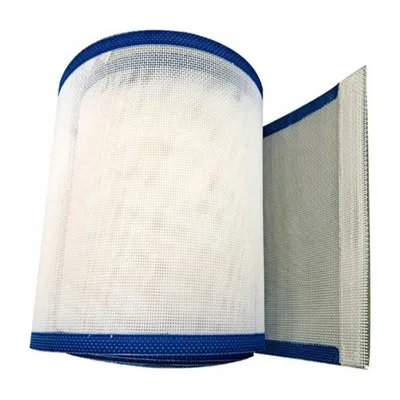
Hey there! As a supplier of Polyester Plain Woven Mesh Belt, I often get asked about the elasticity modulus of this product. So, I thought I'd write this blog to break it down for you.
First off, let's understand what the elasticity modulus is. In simple terms, the elasticity modulus, also known as Young's modulus, measures how stiff a material is. It's the ratio of stress (force per unit area) to strain (the deformation of the material) in the linear-elastic region of a material's stress-strain curve. In other words, it tells us how much a material will stretch or compress when a force is applied to it.
Now, let's talk about Polyester Plain Woven Mesh Belt. Polyester is a synthetic polymer that's known for its durability, strength, and resistance to chemicals and abrasion. When it's woven into a mesh belt, it creates a flexible yet sturdy material that's widely used in various industries, such as food processing, packaging, and textile manufacturing.
The elasticity modulus of a Polyester Plain Woven Mesh Belt can vary depending on several factors. One of the main factors is the type of polyester used. There are different grades of polyester, each with its own unique properties. For example, high-strength polyester will have a higher elasticity modulus compared to regular polyester.
Another factor that affects the elasticity modulus is the weaving pattern of the mesh belt. A tighter weave generally results in a higher modulus because it restricts the movement of the polyester fibers, making the belt stiffer. On the other hand, a looser weave allows for more flexibility and a lower modulus.
The thickness of the mesh belt also plays a role. Thicker belts tend to have a higher elasticity modulus because they have more material to resist deformation. Additionally, the diameter of the polyester fibers used in the belt can impact the modulus. Smaller diameter fibers can increase the surface area and the number of fiber-fiber interactions, which can lead to a higher modulus.
Typically, the elasticity modulus of a Polyester Plain Woven Mesh Belt ranges from about 1 to 5 GPa (gigapascals). However, this is just a rough estimate, and the actual value can be outside of this range depending on the specific characteristics of the belt. To get an accurate measurement of the modulus for a particular belt, it's best to conduct a mechanical test using a device called a tensile testing machine. This machine applies a controlled force to the belt and measures the resulting deformation, allowing us to calculate the modulus.
So, why is the elasticity modulus important? Well, it has several practical implications. In applications where precision is crucial, such as in the printing or electronics industries, a belt with a high elasticity modulus is preferred. This is because it can maintain its shape and dimensions more accurately under load, ensuring consistent performance.
On the other hand, in applications where flexibility is needed, like in some types of conveyor systems where the belt needs to bend around pulleys easily, a lower modulus belt might be a better choice.
If you're in the market for a Polyester Plain Woven Mesh Belt, it's essential to consider the elasticity modulus based on your specific requirements. You might also want to explore other related products, such as the Polyester Spiral Mesh Conveyor Belt, the Polyester Mesh Fabric Conveyor Belt, or the Polyester Mesh Conveyor Belt. These belts offer different features and benefits that might suit your needs better.


Understanding the elasticity modulus of a Polyester Plain Woven Mesh Belt is crucial for selecting the right belt for your application. By considering factors like the type of polyester, weaving pattern, thickness, and fiber diameter, you can get a better idea of the belt's stiffness and how it will perform under load.
If you're interested in learning more about our Polyester Plain Woven Mesh Belts or have any questions about the elasticity modulus or other properties, don't hesitate to reach out. We're here to help you find the perfect solution for your business. Whether you're a small startup or a large corporation, we can work with you to meet your specific requirements. So, let's start a conversation and see how we can assist you in your procurement process.
References
- "Mechanical Properties of Polymers" by R. N. Haward
- "Textile Materials: Science and Technology" edited by W. E. Morton and J. W. S. Hearle