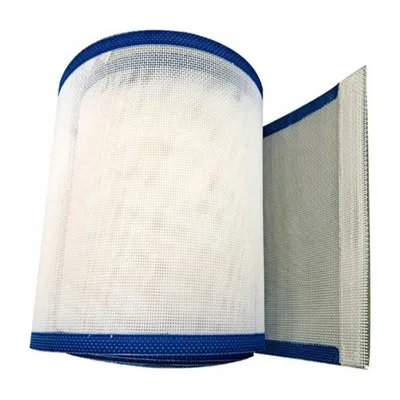
Hey there! As a supplier of Paper Machine Forming Wires, I've been in the thick of the paper industry for quite some time. One question that often pops up is, "What's the relationship between the mesh size of paper machine forming wires and paper quality?" Well, let's dive right in and break it down.
First off, let's understand what paper machine forming wires are. These wires are a crucial part of the paper - making process. They're like the foundation on which the paper takes shape. You can check out more about Paper Machine Forming Wire on our website.
The mesh size of these forming wires refers to the number of openings per linear inch in the wire. It can vary widely, and this variation has a significant impact on the paper quality.
Impact on Drainage
One of the most important aspects affected by the mesh size is drainage. When the pulp is laid on the forming wire, water needs to drain out quickly so that the fibers can start to bond and form paper. A coarser mesh size, with larger openings, allows water to drain more rapidly. This is great for high - speed paper machines where quick drainage is essential to keep up with production.
However, if the mesh is too coarse, it can cause problems. The large openings might let some of the fibers pass through along with the water. This leads to a loss of fibers, which can result in a weaker paper with lower strength properties. On the other hand, a finer mesh size has smaller openings. This slows down the drainage process. While it might seem counter - productive, in some cases, it can be beneficial. For papers that require a very smooth surface and high uniformity, a slower drainage rate can help the fibers arrange themselves more evenly, resulting in a better - quality paper. You can learn about different types of forming meshes, like the One and Half Layer Forming Mesh, which are designed with specific mesh characteristics for different paper - making needs.
Influence on Paper Surface Smoothness
The mesh size also plays a big role in determining the surface smoothness of the paper. A finer mesh size tends to produce a smoother paper surface. The smaller openings in the wire prevent the fibers from being pushed too deeply into the wire, reducing the imprint of the wire on the paper. This is especially important for papers used in printing, where a smooth surface is necessary for sharp and clear printing results.
In contrast, a coarser mesh can leave a more pronounced wire pattern on the paper surface. This might not be a problem for some types of papers, like packaging papers, where surface smoothness is not the top priority. But for high - end papers, such as those used in magazines or art prints, a coarser mesh could lead to an unacceptable surface finish.
Effect on Paper Strength
Paper strength is another critical factor affected by the mesh size. As mentioned earlier, a very coarse mesh can cause fiber loss during the drainage process. When fibers are lost, there are fewer of them available to bond together, resulting in a weaker paper.
A finer mesh, on the other hand, helps to retain more fibers on the wire. This allows for better fiber - to - fiber bonding, which generally leads to a stronger paper. However, if the mesh is too fine, it can also cause issues. The slow drainage can lead to a more compacted fiber mat, which might reduce the paper's porosity and flexibility, affecting its overall strength and performance.
Uniformity of Paper
Uniformity is key when it comes to paper quality. A well - formed paper should have a consistent distribution of fibers throughout its structure. The mesh size of the forming wire can greatly influence this uniformity.
A finer mesh size promotes better fiber distribution. The smaller openings in the wire help to spread the fibers more evenly as the water drains. This results in a paper with more consistent thickness, density, and strength across its surface. In contrast, a coarser mesh might cause the fibers to clump together in some areas and be sparse in others, leading to an uneven paper with variations in quality.


Choosing the Right Mesh Size
So, how do you choose the right mesh size for your paper - making process? Well, it depends on several factors. The type of paper you're making is the most important consideration. For example, if you're making newsprint, which requires high - speed production and doesn't need a super - smooth surface, a coarser mesh might be suitable. But if you're producing fine writing paper or photographic paper, a finer mesh would be a better choice.
The speed of your paper machine also matters. High - speed machines generally require a mesh size that allows for fast drainage to keep up with the production rate. But you also need to balance this with the quality requirements of the paper.
Another factor is the pulp characteristics. Different pulps have different fiber lengths, shapes, and densities. Some pulps might drain more easily than others, and this can influence the choice of mesh size.
We offer a wide range of Paper Machine Polyester Forming Fabric with various mesh sizes to meet different customer needs. Whether you're looking for a coarser mesh for high - speed production or a finer mesh for premium paper quality, we've got you covered.
Conclusion
In conclusion, the relationship between the mesh size of paper machine forming wires and paper quality is complex but crucial. The mesh size affects drainage, surface smoothness, paper strength, and uniformity. Choosing the right mesh size is a balancing act that requires considering the type of paper, machine speed, and pulp characteristics.
If you're in the paper - making business and looking to improve your paper quality or optimize your production process, we're here to help. We have the expertise and a wide range of products to meet your specific requirements. Don't hesitate to reach out and start a conversation about how our Paper Machine Forming Wires can make a difference in your paper - making operations. Let's work together to produce high - quality paper that meets your customers' expectations.
References
- "Handbook of Pulp and Paper Technology"
- "Paper Machine Clothing: A Practical Guide"