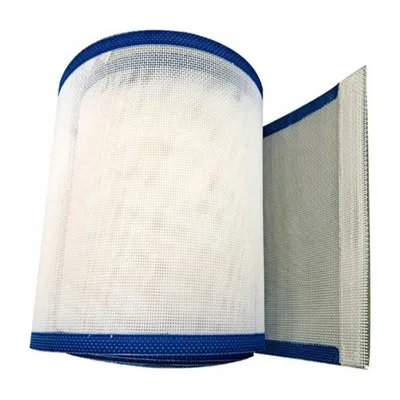
In the realm of papermaking and various industrial applications, the selection of the right forming materials is crucial for achieving high - quality products and efficient production processes. Among these materials, the Two And Half Layer Forming Wrie stands out as a remarkable innovation, offering a unique set of properties and capabilities. As a supplier of Two And Half Layer Forming Wrie, I am excited to explore its diverse applications with you.
Introduction to Two And Half Layer Forming Wrie
Before delving into its applications, let's briefly understand what Two And Half Layer Forming Wrie is. It is a type of advanced fabric structure that combines the characteristics of different layers to provide enhanced performance. Compared with Polyester Single Layer Forming Fabric which typically has a more straightforward single - layer construction, and One and Half Layer Forming Mesh with its relatively simpler layer combination, the Two And Half Layer Forming Wrie offers a more complex and optimized structure.
The two - and - a - half - layer design usually consists of a main structural layer, an additional support layer, and a partial or "half" layer that can be tailored to specific functions. This unique configuration gives it a balance of strength, drainage properties, and surface smoothness, making it suitable for a wide range of demanding applications.
Papermaking Industry
The papermaking industry is one of the primary consumers of Two And Half Layer Forming Wrie. In the paper machine's forming section, the fabric plays a vital role in the initial stage of sheet formation.
Sheet Formation
When the pulp slurry is sprayed onto the forming fabric, the Two And Half Layer Forming Wrie helps in the efficient drainage of water while ensuring proper fiber orientation. The main layer provides the necessary strength to withstand the mechanical forces during the papermaking process, such as the tension from the machine's drive system. The support layer enhances the fabric's stability, preventing it from stretching or deforming under the pressure of the slurry flow. The half - layer can be engineered to have a specific surface texture that promotes better fiber entanglement, resulting in a more uniform paper sheet. This uniformity is crucial for producing high - quality paper products, whether it is fine printing paper or packaging board.
Drainage Performance
Good drainage is essential for the papermaking process as it directly affects the production speed and the quality of the final paper. The Two And Half Layer Forming Wrie is designed to have excellent drainage properties. The open structure of the layers allows water to pass through quickly, reducing the time required for the sheet to reach the desired dryness level. This not only increases the productivity of the paper machine but also helps in reducing energy consumption associated with subsequent drying processes.
Surface Quality
The surface smoothness of the forming fabric is transferred to the paper sheet during the forming process. The Two And Half Layer Forming Wrie can be manufactured with a smooth surface finish, which imparts a similar smoothness to the paper. This is particularly important for papers used in printing applications, where a smooth surface ensures better ink transfer and sharper image quality.
Non - Woven Fabric Production
In the non - woven fabric industry, the Two And Half Layer Forming Wrie also finds significant applications.
Fiber Laydown and Bonding
Non - woven fabrics are made by bonding fibers together through various methods, such as thermal bonding, chemical bonding, or mechanical entanglement. The forming fabric is used to support the fiber web during the initial laydown process. The Two And Half Layer Forming Wrie provides a stable surface for the fibers to be deposited on. Its unique structure allows for even distribution of fibers, leading to a more consistent non - woven fabric in terms of thickness, density, and strength.
The half - layer in the fabric can be designed to have special features that promote better bonding between the fibers. For example, it can have a rough surface texture that enhances the mechanical entanglement of the fibers or a treated surface that facilitates chemical bonding.
Drying and Processing
After the fibers are laid down and bonded, the non - woven fabric often needs to go through a drying process. The Two And Half Layer Forming Wrie's good drainage and air permeability properties make it suitable for use in drying sections. It allows hot air to pass through the fabric and the non - woven web efficiently, speeding up the drying process and ensuring uniform drying throughout the fabric.
Filtration Applications
The Two And Half Layer Forming Wrie can also be used in filtration applications.
Liquid Filtration
In industrial liquid filtration processes, the fabric can act as a filter medium. The multiple layers of the Two And Half Layer Forming Wrie can trap particles of different sizes. The main layer can provide a coarse filtration stage, removing larger particles, while the support and half - layers can offer finer filtration, capturing smaller contaminants. Its chemical resistance and mechanical strength make it suitable for filtering a wide range of liquids, including water, oil, and chemical solutions.
Air Filtration
In air filtration systems, the fabric's structure can be optimized to capture dust and other airborne particles. The unique layer configuration allows for a high dust - holding capacity while maintaining good air flow. This makes it useful in applications such as industrial ventilation systems, air conditioning units, and cleanroom environments.
Other Industrial Applications
Beyond papermaking, non - woven production, and filtration, the Two And Half Layer Forming Wrie has other potential applications.
Conveyor Belt
In some industrial conveyor systems, the fabric can be used as a conveyor belt. Its strength and flexibility make it suitable for transporting various materials, especially those that require a smooth and stable surface for conveyance. The fabric's ability to resist wear and tear ensures a long service life in conveyor applications.
Textile Processing
In the textile industry, the fabric can be used in processes such as fabric finishing and dyeing. It can provide a stable support for the textile during treatment, ensuring uniform processing and high - quality results.
Why Choose Our Two And Half Layer Forming Wrie
As a supplier of Two and Half Layer Forming Wrie, we are committed to providing high - quality products. Our Two And Half Layer Forming Wrie is manufactured using advanced production techniques and the latest materials, ensuring consistent quality and performance.
We understand that different applications have different requirements. That's why we offer customizable solutions. Whether you need a specific surface texture, a different layer thickness, or enhanced chemical resistance, our technical team can work with you to develop a product that meets your exact needs.
Moreover, we provide excellent after - sales service. Our customer support team is always ready to answer your questions and solve any problems you may encounter during the use of our products.
Conclusion and Call to Action
The Two And Half Layer Forming Wrie is a versatile material with a wide range of applications in various industries. Its unique structure and properties make it an ideal choice for achieving high - quality products and efficient production processes.
If you are interested in our Two And Half Layer Forming Wrie or have any questions about its applications in your specific industry, please feel free to contact us. We look forward to the opportunity to discuss your requirements and provide you with the best solutions.


References
- "Handbook of Papermaking and Paperboard Manufacturing", various authors, Publisher: Wiley - Blackwell
- "Non - woven Fabric Technology and Applications", Author: XYZ, Publisher: ABC Press
- "Filtration Engineering Principles", Author: DEF, Publisher: GHI Publications